Difference Between Stain and Paint for a Wood Deck: What 25 Years of Florida Decks Have Taught Me
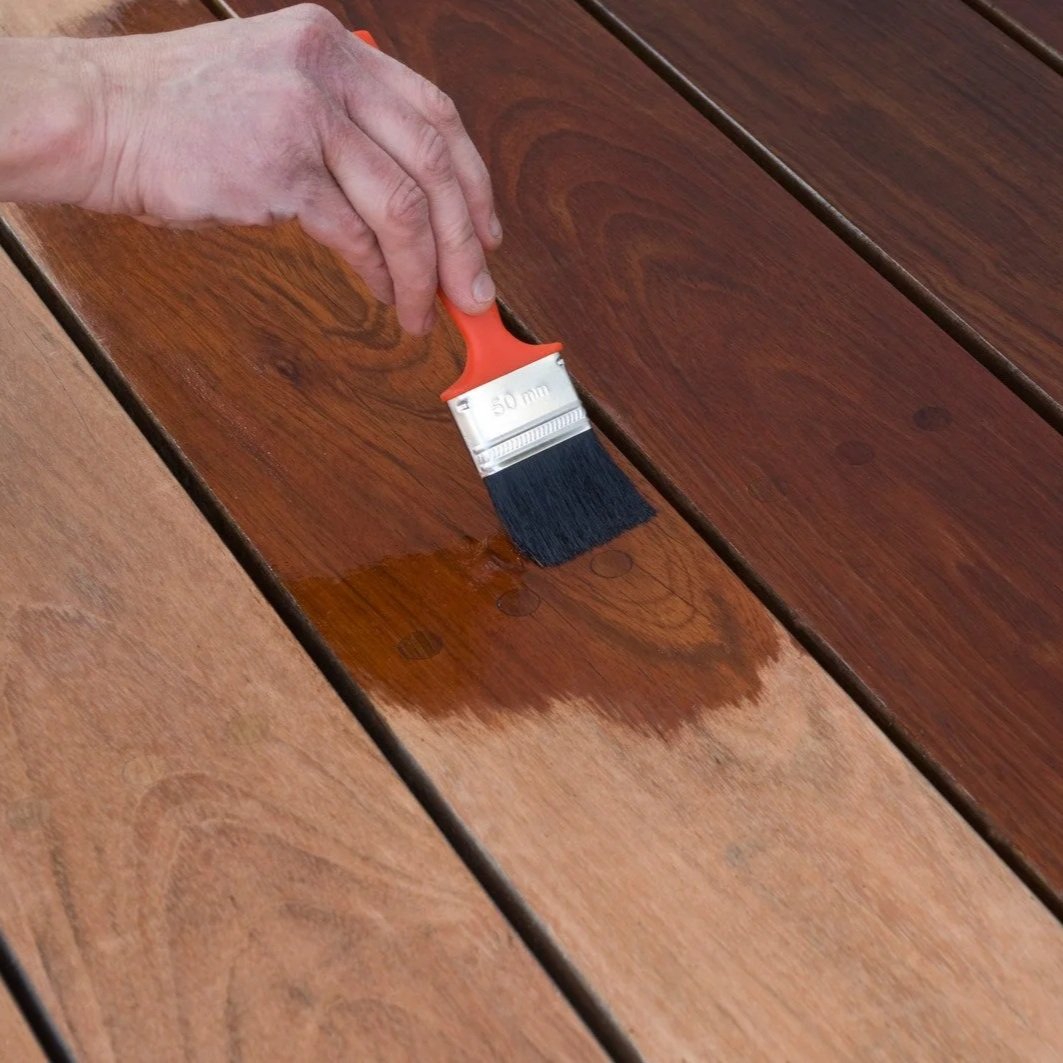
Applying rich wood stain on outdoor deck boards, demonstrating why stain outperforms paint on humid Florida exterior surfaces.
A homeowner in Apollo Beach asked me to look at her deck last summer. Three years before, she'd hired another company to apply a deck resurfacer — the thick, paint-like product that comes in five-gallon buckets and promises to lock everything down. By year three, half the coating had peeled, the boards underneath had rotted, and she was facing a full rebuild. She asked me what she should have done instead. The honest answer involves knowing the difference between paint and stain on a wood deck, and why that difference matters more in Florida than almost anywhere else.
I'm Mark Savino. My crews and I have been painting and staining houses across Tampa Bay for 25-plus years, and we've put coatings on decks from Belleair down to Plant City. Here's what's actually different between deck stain and deck paint, why the wrong choice can rot a deck, and how I decide which one goes on a Florida job.
The Short Answer
Stain penetrates into wood; paint and "deck resurfacers" build a film on top. Penetrating stains hold up better on the horizontal surface of a Florida deck because there's no film to crack when the wood expands and contracts in our humidity. Paint and thick resurfacers have a known peeling problem on horizontal exterior surfaces — known well enough that a major brand faced a class-action lawsuit over it. On almost every Tampa Bay wood deck job, stain is the answer. Paint and resurfacers have narrow legitimate uses, and you should understand them before you spend a weekend rolling one on.
That's the verdict. Here's what's actually different.
What Deck Stain Actually Is
Stain is a penetrating finish. Pigment and binder soak down into the wood pores rather than building a film on top. The U.S. Forest Products Laboratory — the federal research arm that publishes the technical reference for exterior wood finishes — groups exterior coatings into two categories. Penetrating finishes (preservatives, water repellents, semi-transparent stains) work from the inside of the wood. Film-forming materials (paints, solid-color stains, varnishes) work from the outside.
Stain comes in four opacity tiers, defined by how much pigment is in the can:
Clear or transparent. Almost no pigment. Wood grain shows fully. Sherwin-Williams sells SuperDeck Transparent in this category. The catch in Florida — no pigment means no UV protection.
Semi-transparent. Light pigment. Grain still visible. Sherwin's SuperDeck Semi-Transparent and Behr Premium Semi-Transparent are the main retail examples.
Semi-solid. Heavier pigment. Grain mostly hidden, but you can still see the wood texture. SW SuperDeck Semi-Solid fits here.
Solid. Full pigment, no visible grain. The closest a stain gets to paint, but it still penetrates rather than building a thick film. SW SuperDeck Solid and Behr Premium Solid Color Waterproofing Stain & Sealer are the workhorses.
What Deck Paint Actually Is
Deck paint is a film-forming coating. A continuous layer sits on top of the wood and hides the grain entirely. In the deck product category, the heavy players are marketed as "resurfacers" — thick, paint-class coatings sold to cover splinters and cracks up to a quarter inch wide. Behr Premium Advanced DeckOver, KILZ Over Armor Smooth, and Rust-Oleum RockSolid 20X Deck Resurfacer are the three you'll see at Home Depot and Lowe's. They share a common product positioning — 100% acrylic, around 75 square feet per gallon at the recommended thickness, marketed as a one-step solution to restore a worn deck.
The trouble is that the trouble shows up later.
The Data, Side-by-Side
Here's where the categories sit on the axes that matter.
| Performance axis | Penetrating stain | Deck paint / resurfacer |
|---|---|---|
| Adhesion mechanism | Soaks into wood pores | Bonds top surface as a film |
| Hides cracks and splinters | No | Yes (paint-class resurfacers built to fill 1/4" gaps) |
| UV protection | Scales with pigment — solid stain blocks UV | Film + opaque pigment blocks UV well, when intact |
| Foot traffic / abrasion | Wears evenly, no peeling | Resists abrasion when intact; peels when it fails |
| Reapplication | Clean and reapply; minimal prep | Full strip / sand / recoat if film has failed |
| Slip resistance | Most stains have no built-in grit | Some resurfacers market a textured slip-resistant finish |
| Cure time | Most water-based stains 24–72 hr full cure | Most resurfaces 72 hr full cure before traffic |
| Vapor breathability | Wood breathes through the finish | Film traps moisture in the wood |
The manufacturer’s warranties tell a story by themselves.
| Behr deck product | Manufacturer-stated warranty |
|---|---|
| Behr Premium Solid Color Waterproofing Stain & Sealer | 10 years horizontal / 25 years vertical |
| Behr Premium Semi-Transparent Waterproofing Stain & Sealer | 6 years horizontal / 8 years vertical |
| Behr Premium Advanced DeckOver (resurfacer) | 1 year |
A solid stain from the same manufacturer carries ten times the horizontal warranty of their flagship deck resurfacer. That asymmetry isn't an accident — it's the manufacturer telling you, through the warranty fine print, which product is going to outlast which.
The Peeling Problem
Wood moves. A pressure-treated pine deck board in Tampa Bay swells with humidity, shrinks in the dry winter weeks, and expands again under summer sun. A film coating that doesn't flex with the wood cracks at the joints between boards. Once water gets under the film, the film lifts. That's the peeling pattern I see on failed-paint deck jobs — boards intact under the lifted coating, but the coating itself is flaking like old wallpaper.
Penetrating stain avoids this by design. There is no film to crack. Solid stain — closer to a film than a semi-transparent — has more mechanical risk than thinner stains, but still less than a true resurfacer film.
This isn't theoretical. In 2017, multiple class-action lawsuits were filed against Behr alleging that DeckOver bubbled, cracked, and peeled away from decks within months of application. The lead case — Gober v. Behr Process Corp. (Case No. 8:17-cv-01282, Central District of California) — brought claims from seven homeowners across seven states, with a separate Illinois federal case raising similar allegations. The litigation resolved through a class-action settlement that received preliminary approval in 2018, documented by class-action tracking sites including Top Class Actions and Sauder Schelkopf. This isn't bashing Behr — my crews buy Behr Marquee by the bucket. It's the documented industry reality on what happens when you put a thick paint-class film on a horizontal wood surface in a humid climate.
Wood Substrate Considerations
The deck material matters more than the coating choice in some cases.
Pressure-treated southern yellow pine. The default U.S. deck material and the dominant deck wood in Tampa Bay. PT lumber arrives at the lumberyard saturated with water and preservative chemicals. Finishes won't bond until the wood dries. The industry rule — drop a few water beads on the board. If the water absorbs within ten minutes, the wood is ready for stain. If the water beads up and sits there, wait longer. YellaWood, one of the biggest southern-yellow-pine PT brands, publishes this water-bead test as the standard. KDAT lumber — kiln-dried after treatment — is the exception and can be finished sooner.
Cedar and redwood. Softer woods with prettier grain. Stain is preferred because part of the appeal is grain visibility. The paint works, but it masks the wood entirely, and if you wanted that, you'd have built the deck in a cheaper material.
Composite decking — Trex, TimberTech AZEK, and similar. Don't paint or stain it. Both manufacturers say so explicitly. Trex's technical bulletin specifies that the top surface of their decking can't be painted or stained. TimberTech AZEK's warranty voids the moment you apply coating. Composite is a maintenance-free material; trying to "refresh" it with paint creates the very problem the material is sold to avoid.
Old, weathered, gray wood. UV-degraded surface fibers are basically dead, and a clear sealer won't bond to them. A gray, neglected deck needs either brightening and sanding back to fresh wood before clear or semi-transparent stain, or a recoat with solid stain or paint that hides the past entirely.
Where Stain Earns Its Place
Here's where I reach for stain on Tampa Bay jobs.
Any wood deck that's never been painted. Default is stain. Period. Pressure-treated, cedar, or whatever's down there, if it's never had a film coating, keep it that way. The semi-transparent stain shows the grain and lasts about 3 years in the Florida sun on horizontal surfaces. Solid stain is the next step up and runs closer to 5-7 years horizontal in my experience, longer on shaded surfaces.
Decks where the customer wants to see the wood. Semi-transparent or semi-solid. The owner of a Belleair waterfront home with a tigerwood deck doesn't want it painted gray. Use stain.
Coastal decks. Salt air corrodes deck hardware and wears coatings faster. Penetrating stain breathes; water that gets into the boards gets out again. A paint film traps the moisture against the wood, which, on a beach property, is asking for rot.
Heavily shaded decks under live oaks. Mildew loves a shaded humid surface. Stain with a strong mildewcide additive is the right answer; the breathable film won't trap moisture between coating and wood.
Where Paint or a Resurfacer Has a Legitimate Place
I'll be honest — there are use cases. They're narrower than the marketing implies.
An already-painted deck that the customer doesn't want to strip. Stripping paint off deck boards is brutal, expensive work. If the previous owner painted the deck and the paint is mostly sound, recoating with another deck paint or resurfacer is sometimes the practical move — with the understanding that you're inheriting the previous failure mode.
A badly cracked or splintered deck that's borderline replacement. A thick resurfacer can extend the deck's life by a year or two while the homeowner saves for a rebuild. Don't expect the resurfacer to be permanent. Expect to redo it.
Solid-color decks for a specific architectural look. A coastal cottage with a porch, the owner wants painted white to match the trim. Solid stain is usually the better call here, even when paint is the aesthetic goal — same finish, longer warranty.
Concrete pool decks and pool surrounds. Different category entirely. Specialty exterior concrete coatings, not wood-deck products.
What Each One Gets Wrong
Both products fail in their own ways.
Stain's weaknesses. It doesn't hide cracks, splinters, or repaired patches. Clear stain gives no UV protection — wood grays underneath within a year. Semi-transparent runs through its pigment about every three years in the Florida sun. Reapplication is easy and doesn't require stripping and sanding. But it does need to happen on a schedule.
Paint and resurfacer weaknesses. The peeling problem is real and well-documented. Once the film fails, the only fix is full removal — scrape, sand, recoat. Resurfacers also trap moisture against the wood, which accelerates rot underneath if the deck has any standing-water issues. The warranty asymmetry I cited above isn't marketing — it's manufacturer-stated reality.
Two Things Most Articles On This Topic Skip
The top-ranked articles on this question cover the basics — paint sits on top, stain soaks in. Two pieces of information that actually matter on a real Florida job rarely show up.
Manufacturer warranties tell the truth. Behr's own warranty on their solid stain is 10 years horizontal. Their warranty on the DeckOver resurfacer is 1 year. That isn't a typo. Behr is telling you, through their fine print, which product they expect to last. Every major article on stain vs paint glosses past this. It's the most useful single data point in the entire category.
Pressure-treated lumber has a waiting period. Most articles say "stain or paint" without acknowledging that fresh PT lumber can't take either for several months. YellaWood publishes the water-bead test as the proper readiness check. I see homeowner DIY jobs fail every spring because somebody hit the deck with stain a week after the lumber was installed — the water hadn't even started to dry out of the boards, and the stain had nowhere to soak in.
The Florida Factor
Tampa Bay's climate stacks the deck against any horizontal exterior finish. Annual humidity averages 74 percent. Summer UV index regularly hits 12. We get 50 to 60 inches of rain a year, concentrated in afternoon thunderstorms that hit horizontal surfaces straight down. Coastal homes from Apollo Beach to Indian Rocks get aerosolized salt that corrodes hardware and accelerates coating wear.
Penetrating stain breathes through all of this. Paint and resurfacers fight it.
A specific note for coastal homeowners: the International Residential Code requires stainless steel — type 316 specifically — for fasteners and connectors within 300 feet of saltwater. Even the best stain or paint won't save a deck whose screws are rusting out from the underside. If your deck is in salty range, check the fasteners before you spend money on the coating.
When the Customer Asks Me Which to Buy
Here's how the conversation usually goes in my truck on the driveway.
Pressure-treated pine deck in Carrollwood, never painted, owner wants it to look good and last — semi-transparent or semi-solid stain. Three-year refresh cycle. Plan for it.
Cedar wraparound porch in South Tampa with original wood that needs to keep showing — semi-transparent stain in a tone that matches the original finish.
Coastal deck in Apollo Beach on the water, fasteners look questionable — fix the hardware first. Then solid stain.
Deck someone painted with a resurfacer three years ago, and it's peeling — strip, sand, recoat with another resurfacer if they're really attached to the look. Better answer: strip, sand, and switch to solid stain.
Badly cracked deck, the owner says, is two years from a rebuild — solid stain as a holding action. Acknowledge it's not a permanent fix.
Composite deck someone's trying to refresh because they don't like the color — don't paint it, don't stain it. The warranty voids. The right answer is buying new boards in the color you want.
That's not a formula. That's how a quarter century of doing this teaches you to read what the deck is going through and what the homeowner actually wants.
What the Data Won't Tell You
A few honest things to flag.
The 2-to-3-year service life for solid stain on Florida horizontal surfaces and the 3-year service life for semi-transparent are industry rules of thumb, not manufacturer-stamped guarantees. Behr's warranty language is generous compared to actual service life; the warranty pays out on the product, not on the labor and prep. Plan for re-coating sooner than the warranty implies.
Pricing varies. Semi-transparent stains at Home Depot run $40 to $50 per gallon. Solid stain runs $45 to $55. Premium finishes from specialty brands like PPG ProLuxe can hit $110. Resurfacers run $30 to $50 per gallon but cover less area (about 75 sq ft, vs 150-250 for stain), so the per-square-foot cost is comparable.
The DeckOver class-action litigation is documented in the public legal record — the lead case is Gober v. Behr Process Corp. in the Central District of California. My crews buy plenty of Behr products, and I'm not telling you to avoid the brand. I'm telling you the industry knows resurfacers fail on horizontal surfaces, and the record proves it.
Frequently Asked Questions
Stain, in nearly all cases. The penetrating stain doesn't peel because there's no film to crack when the wood moves. Paint and thick resurfacers can peel on horizontal exterior surfaces, especially in humid climates like Tampa Bay.
You can, but you shouldn't unless you have a specific reason. The stain has soaked into the wood and is doing its job. Adding paint over it puts a film on top with the same peeling risk as painting raw wood.
Semi-transparent stain about 3 years on horizontal Florida surfaces. Solid stain about 5 to 7 years horizontal, longer in shade or on vertical surfaces. Clear sealer is gone within a year in Florida’s sun.
Not without stripping the paint. Stain needs raw wood pores to penetrate into. A painted surface is sealed, and the stain has nowhere to go. Strip back to wood first.
A thick paint-class coating marketed to cover cracks and splinters up to a quarter inch wide. Behr DeckOver, KILZ Over Armor, and Rust-Oleum RockSolid 20X are the major examples. They have a documented peeling history on horizontal surfaces; I rarely recommend them for new deck jobs.
No. Pressure-treated lumber is saturated when delivered. Wait until the water-bead test passes — drop water on a board, and if it absorbs within ten minutes, the wood is ready. Often, that's three to six months from install, sometimes longer.
Neither. Both manufacturers void their warranties if you apply a coating. Composite is sold as a no-maintenance material; trying to refresh it with a coating creates the problem you bought composite to avoid.
For almost every wood deck in Tampa Bay, stain is the right answer. Semi-transparent if you want to see the grain, solid if you want full color and longer life. Plan to recoat every 3 to 7 years, depending on the product, exposure, and traffic.
Reach for paint or a deck resurfacer only when you're inheriting an already-painted deck the owner doesn't want to strip, or when you're holding off a rebuild for a year or two. Know the peeling risk going in.
Don't paint or stain a composite deck. The warranty voids the moment you open the can.
Whatever you put down, prep matters more than product. Clean the deck. Let it dry. Test the water-bead. Replace failed fasteners. The coating is the last 30 percent of a deck job — the first 70 happens before you open the can.
If you're looking at a Tampa Bay deck and trying to decide between stain and paint — or trying to rescue a deck that someone else painted and you can't keep up with the peel — give us a call at (813) 831-5433 or request a free estimate. We'll walk the deck with you, tell you what we think it needs, and quote it honestly.
