Popcorn Ceiling Removal vs. Skim Coat: Which Wins?
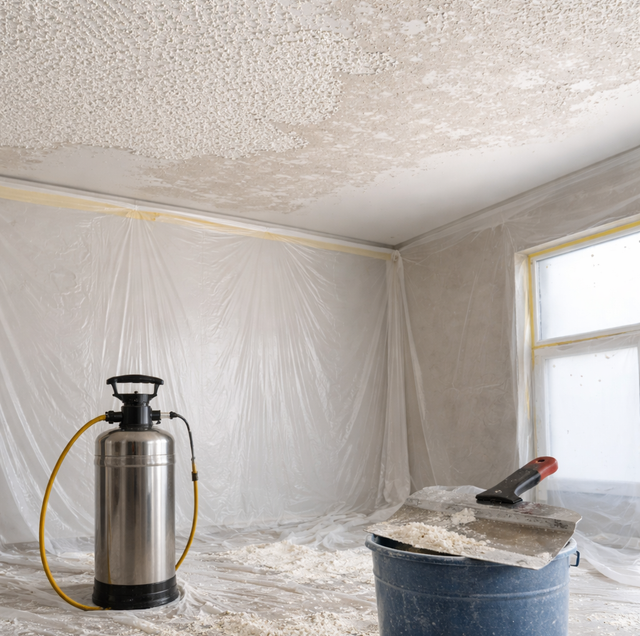
Quick Answer: Two paths lead to a smooth ceiling. You can scrape the popcorn texture off and finish the bare drywall, or you can skim a thin coat of joint compound over the texture to flatten it. Scraping gives the cleanest result but makes the biggest mess and depends on the ceiling being unpainted and asbestos-free. Skim coating buries the texture in place, which is faster and often the safer choice when the ceiling is painted or when older texture might contain asbestos. Before either job starts on a home built or finished before the mid-1980s, the texture must be lab tested for asbestos.
That cottage-cheese ceiling overhead has two exits, and picking the wrong one costs you time, money, and sometimes a health hazard. This walks through what each method actually involves, the factors that push a ceiling toward one or the other, and how the finish gets painted once the surface is flat.
Test For Asbestos Before You Touch It
The single most important step happens before any tool comes out. Popcorn texture applied to homes built or finished before the mid-1980s can contain asbestos, and there is no way to tell by looking. Two ceilings can look identical, and one is harmless while the other releases microscopic fibers the moment it is disturbed.
The only reliable answer comes from a lab. A small sample is collected, lightly misted so it does not release dust, and sent for analysis. Until that result is back, the texture stays untouched.
Popcorn texture in homes built or finished before the mid-1980s can contain asbestos, and there is no way to tell by looking. Dry-scraping asbestos texture sends fibers airborne throughout the home, the exact exposure route linked to serious lung disease, so positive texture should be removed only by a certified abatement contractor working under containment.
Why the age line matters: The mid-1980s is not an arbitrary date. Asbestos-containing texture products were phased out around then, so a ceiling finished after that window is far less likely to test positive. Homes right on the cusp, or ceilings redone at an unknown date, are exactly the ones worth testing rather than assuming.
What Scraping And Removing Actually Involves
Scraping removes the texture entirely and leaves you finishing the bare drywall underneath. The process works best on texture that was never painted, because unpainted popcorn drinks up water.
The room gets stripped and draped first. Furniture comes out, plastic sheeting goes over the floor and walls, and power to the ceiling light fixtures gets shut off at the breaker so nobody is scraping wet material inches from a live connection. A pump sprayer mists a section of ceiling with warm water, the crew waits several minutes for it to soak in, and a wide drywall knife lifts the softened texture off in sheets. Wet material drops onto the sheeting below instead of drifting as dust.
Once the texture is off, the real finishing begins. The bare drywall almost always shows gouges, exposed seams, and old joint tape that needs attention. A skim coat of compound, sanding, priming, and painting bring it to a smooth finish. Removal is not just scraping; it is scraping followed by a full re-finish.
Where scraping runs into trouble: Painted popcorn texture is the classic complication. Paint seals the surface so water cannot penetrate; the texture refuses to soften, and scraping either fails or tears into the drywall face. A painted ceiling usually has to be either soaked far more aggressively, risking drywall damage, or handled a different way entirely.
What Skim Coating Over The Texture Involves
Skim coating takes the opposite approach. Instead of removing the texture, you flatten it in place by troweling one or more thin layers of joint compound over the whole ceiling, filling the valleys between the bumps until the surface reads flat. Between coats, it gets sanded, then primed and painted.
This method shines in two situations the scraping route struggles with. A painted ceiling that will not wet-scrape can be skimmed without any soaking at all. And when older texture tests positive for asbestos, skimming can serve as encapsulation, locking the fibers under a solid layer rather than disturbing them, though any work on asbestos-containing material should still be discussed with an abatement professional first.
Skim coating is a genuine finishing skill. Getting a wide ceiling flat without visible trowel ridges or telegraphing bumps takes a practiced hand, and the coats have to dry fully between passes. It is less messy than scraping, but it is not a beginner shortcut.
The headroom trade-off: Skimming adds a small amount of thickness to the ceiling, and while it is minor, it is worth noting in a room that already feels low. Scraping goes the other direction; shaving the texture off can gain back a sliver of visual height. In a standard-height room, neither shift is dramatic, but in a low basement or a room with existing crown molding, the direction of the change can matter.
Reading Your Ceiling: Condition And Sag
The physical state of the ceiling steers the decision as much as anything. Run your eye across it in raking light from a window.
A ceiling that is sound, flat, and simply textured is a fair candidate for either method. A ceiling that sags, shows water staining, or has drywall that feels soft is telling you the substrate has a problem, and no surface treatment fixes a failing substrate. Sagging drywall may need to be refastened or replaced before any smooth finish makes sense, which sometimes tips the whole job toward removal since the drywall is being worked on anyway.
Run your eye across the ceiling in raking light from a window. A ceiling that is sound, flat, and simply textured is a fair candidate for either method, but one that sags, shows water staining, or has soft drywall has a substrate problem that no surface treatment can fix on its own.
Think of the texture as wallpaper over a wall. If the wall behind it is solid, you can strip the paper or paper over it. If the wall itself is crumbling, neither choice helps until the wall is fixed. The ceiling works the same way.
Mess, Prep, And The Practical Cost Difference
The two methods feel very different to live through. Scraping is the wetter, messier job up front. Even done carefully, it involves saturated texture sliding onto sheeting, and the finishing work afterward, sanding compound, generates fine dust that finds its way through a house unless the room is sealed off.
Skim coating spreads its mess differently. There is less wet debris, but the sanding phase between compound coats still produces dust, and multiple coats mean the room is out of use for longer while layers dry. Neither job is dust-free, and both reward sealing doorways and running the work in a room the household can avoid for a few days.
On effort, removal usually means more total labor because of the two-stage nature: strip and then refinish. Skim coating can be quicker when the texture is in good shape and only needs a coat or two to flatten. The condition of the ceiling, more than the method name, drives how long the job actually runs.
When Each Method Wins
Scraping tends to win when the texture is unpainted, has tested negative for asbestos, and the drywall underneath is in good shape. You get a true flat ceiling with no added thickness and no texture hiding underneath, which is the cleanest long-term result.
Skim coating tends to win when the ceiling is painted, when older texture has tested positive, and encapsulation is the safer route, or when the household wants a smoother path with less wet demolition. It is also the pragmatic pick when the texture is sound and simply needs flattening rather than a full tear-off.
Neither is universally better. The right call is whichever one matches your ceiling's paint status, asbestos result, condition, and how much disruption the home can absorb.
Finishing And Painting Once It Is Flat
However you arrive at a flat ceiling, the finish coat is what people actually see. Fresh compound and bare drywall are thirsty and uneven in porosity, so a proper primer goes on first to seal the surface and keep the topcoat from flashing into blotchy sheen differences.
Ceilings are almost always painted with a flat sheen for a reason. Flat paint scatters light and hides the minor undulations that survive even good prep, while any sheen above flat rakes across those imperfections and highlights them. Two coats of a quality ceiling paint over primer give an even, uniform result. Cutting in cleanly where the ceiling meets the wall is what separates a finish that looks intentional from one that looks patched.
Frequently Asked Questions
Yes, popcorn texture can be painted, but it behaves differently than a smooth surface. A roller drags on the bumps and can pull loose flakes off, so many pros use a thick-nap roller of about three-quarter inch or spray the paint instead. On never-painted texture, spraying is often preferred because a wet roller can dissolve the water-based texture and smear it. Painting hides discoloration but keeps the bumpy look, so it is a refresh, not a flattening.
A typical thin skim coat of all-purpose joint compound needs roughly 24 hours to dry before sanding and recoating, and high humidity stretches that out considerably. Setting-type compounds, sold as powders labeled with a working time like 45 or 90 minutes, chemically harden much faster and let a crew recoat the same day, which is why they are common on multi-coat ceiling work when the schedule is tight.
Yes. Fixtures, ceiling fans, vent covers, and smoke detectors all come down before scraping or skimming so the surface can be worked edge to edge, and so no compound or water reaches wiring. Kill the breaker to the fixtures before removing them. Smoke detectors should be bagged and set aside rather than left in the dust, since fine sanding dust can clog the sensor chamber and trigger nuisance alarms later.
Often, yes. Popcorn texture was popular partly because it masked imperfect drywall work, so scraping can expose poorly taped seams, nail pops, and patched repairs that were never finished smoothly. Budget mentally for extra taping and skim work after the scrape rather than expecting clean drywall underneath. This is one reason a removal estimate can grow once the texture is actually off.
They overlap but are not identical. The bumpy spray was marketed as an acoustic ceiling because the irregular surface does slightly dampen sound reflection within a room, and some older versions were mixed with vermiculite for that effect. The sound reduction is modest, so flattening a ceiling does not meaningfully change how loud a room feels, despite the old acoustic label.
A skim coat adds a small amount of weight, a thin layer of dried compound spread across the ceiling, and a sound, properly fastened drywall ceiling carries it without issue. The concern isn't the coat's weight but the ceiling's existing condition: if drywall screws or nails are already pulling loose, adding any material to a marginal ceiling is a reason to refasten it first rather than skip skimming.
Book a free ceiling assessment — get a clear removal-or-skim recommendation matched to your ceiling. Mark's Painting serves Tampa Bay and surrounding areas. Licensed & Insured. Call (813) 831-5433.
