Why Is My Paint Bubbling on the Bathroom Ceiling? A Tampa Painter's Diagnostic on Florida's Most Common Ceiling Failure
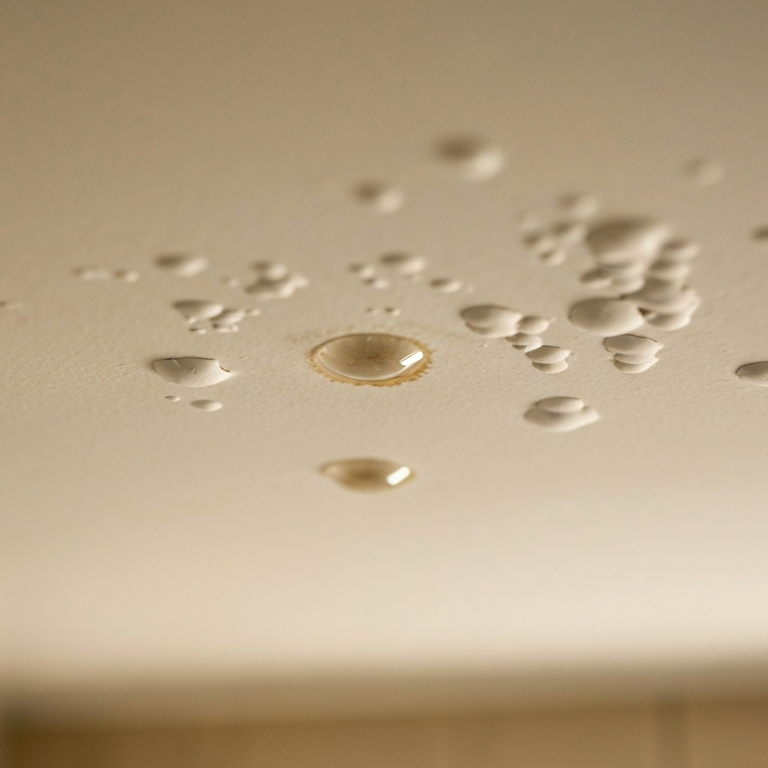
Water bubbles forming on bathroom ceiling paint caused by trapped moisture, poor ventilation, roof leaks, or sweating attic ductwork.
A homeowner in Carrollwood called me about her master bathroom ceiling last summer. Six months after a fresh paint job, the ceiling above the shower had developed a cluster of small blisters. By the time I got there, two of them had popped, leaving brown rings behind. She thought the paint was defective. The honest answer, after twenty minutes in her attic, was that her bathroom exhaust fan was venting straight into the attic instead of out through the soffit, the AC duct above the ceiling was sweating, and shower humidity had nowhere to go. The paint didn't fail. The system around it did.
I'm Mark Savino. I've put paint on more Tampa Bay bathroom ceilings than I can count, and I've torn out more failed bathroom ceiling paint than I'd like to admit. Bubbling bathroom ceilings have few real causes, and in Florida, the diagnosis is usually moisture-related. Here's how I read it.
The Short Answer
When I see paint bubbling on a Tampa Bay bathroom ceiling, the cause is almost always moisture migrating into or through the drywall — from shower steam without adequate ventilation, from a sweating AC duct in the attic above, from a roof leak, or from a paint job applied over a substrate that wasn't dry. The paint film itself is almost never defective. The fix has to address the moisture source first, then the substrate, then the primer, then the paint. Skip any step, and the bubbles come back within a year.
That's the diagnosis. Here's how to actually read it.
What Paint Bubbling Actually Is
Sherwin-Williams' problem-solver gives the definition directly: bubbling and blistering are "bubbles caused from a loss of adhesion and lifting of the paint film from the underlying surface." Sherwin lists two main types: heat blistering from painting on a too-warm substrate, and moisture blistering from water vapor migrating through the wall and pushing the paint film off.
In Tampa Bay bathrooms, there's almost always moisture on the ceiling. Sherwin's own page calls this out specifically: "Exposure of latex paint film to dew, high humidity, moisture, or rain shortly after paint has dried, especially if there was inadequate surface preparation and/or poor ventilation in areas such as kitchens and bathrooms" is a primary cause of blistering. Benjamin Moore's paint-blistering page reinforces the same — loss of adhesion "usually caused by heat, moisture or a combination of both," and the condition "eventually leads to peeling" if the moisture source isn't fixed.
Pop a bubble with a thumbnail. If liquid water comes out, there's an active moisture source above the ceiling — a roof leak, a sweating duct, a failed plumbing line. If only air comes out, the bubble formed during or shortly after application from trapped moisture or solvent, and the source may already be gone.
The 8 Real Causes on a Tampa Bay Bathroom Ceiling
Here are the causes in roughly the order I encounter them on Florida bathroom jobs.
| Cause | What it looks like | Primary fix |
|---|---|---|
| Inadequate bathroom exhaust ventilation | Localized bubbles over the shower; mildew growth at corners | Install or upsize bath fan; verify it vents outside the structure |
| Bath fan illegally vented into the attic | Bubbles spread across the entire ceiling; brown stains | Reroute fan duct to soffit or roof cap |
| AC duct or vent boot condensation above the ceiling | Bubbles clustered around HVAC supply boots | Insulate duct to R-6 minimum; check duct R-value |
| Roof leak above the bathroom | Bubbles with active water; brown ring stains | Repair roof; replace water-damaged drywall |
| Plumbing leak in the wall or floor above | Localized bubbles tracking from one corner outward | Find and fix the leak; replace damaged drywall |
| Painting over a damp substrate | Generalized bubbles across the ceiling within months of repaint | Strip, dry to under 16% moisture content, prime, repaint |
| Wrong sheen for a wet room | Flat or eggshell film absorbing moisture; bubbles plus mildew | Switch to bathroom-rated paint like Aura Bath & Spa or Zinsser Perma-White |
| Painting in high heat or humidity without dehumidification | Bubbles within days of application | Run AC; dehumidify the room during paint and cure |
The single most common cause I see in Tampa Bay? An undersized or non-functional bath fan, combined with the homeowner not running it during showers. Steam saturates the drywall, has nowhere to go, and the paint fails from the back side.
The Bath Fan Problem
Most Tampa Bay bathrooms built before 2010 have problems with the exhaust ventilation. Either the fan is undersized for the room, or it doesn't get used during showers, or — most catastrophically — it vents into the attic instead of through the soffit or roof cap.
The Home Ventilating Institute recommends a minimum of 1 CFM per square foot of bathroom floor area, with 50 CFM as the absolute floor. A 50 square foot master bathroom needs at least 50 CFM; a 100 square foot bathroom needs 100 CFM. Older Tampa homes often have 30 to 50 CFM fans serving rooms that need twice that capacity.
The bigger problem is where the fan vents. Florida Building Commission rulings make clear that "outside" means outside the structure — venting into a vented attic isn't compliant. I see code-illegal venting in maybe one of three older bathrooms I inspect. The hot moist shower air dumps into the attic, condenses on the underside of the roof deck or on a cold AC duct, and rains back down through the insulation onto the back of the bathroom ceiling drywall. The paint bubbles on the side facing the bathroom, but the moisture is coming from above.
The fix: Trace the fan duct from the bathroom ceiling. If it ends in the attic, reroute it to a soffit vent or a roof cap. If it ends at a soffit, but the run is too long or has tight bends, that's also reducing the effective CFM. A good HVAC contractor can sort it in a day.
The AC Duct Sweat Problem
This one almost no one connects to the paint failure. Tampa Bay AC supply ducts run at 55 to 65 degrees Fahrenheit. Florida vented attic air in summer routinely hits 120 to 140 degrees with 70 to 80 percent relative humidity. A cold metal duct or vent boot sitting inside that hot wet attic becomes a condensing surface. Water beads up on the outside of the duct, drips through the insulation, and lands on the bathroom ceiling drywall.
The paint bubbles in a cluster centered on the AC supply boot in the ceiling — usually a 2 to 3 foot zone. The homeowner doesn't think to look above the ceiling because the bathroom side looks like a paint problem. It's not. It's a duct insulation problem.
The fix: Insulate the duct to a minimum of R-6, as required by the Florida Building Code. The Tampa HVAC contractors I work with regularly find ducts with deteriorated insulation, gaps in the insulation jacket, or the original builder-grade insulation that's compressed to half its rated value.
The Right Paint for a Bathroom Ceiling
Once the moisture source is fixed, the topcoat matters.
Benjamin Moore Aura Bath & Spa is the premium pick. The matte finish reads soft like a ceiling paint should, but the formula is engineered specifically for repeated humidity exposure. Mildew-resistant additive package in the can. The line is the only mainstream interior paint I know of designed specifically for bathrooms in a matte sheen.
Zinsser Perma-White Mold & Mildew-Proof Interior Paint is the budget alternative. Self-priming comes in satin/eggshell/semi-gloss, and Rust-Oleum backs it with a 5-year mold and mildew-proof film guarantee. Two coats are required for the warranty.
General rule for bathroom ceilings: lower-sheen films are more porous and absorb moisture faster. A satin or semi-gloss ceiling paint resists vapor penetration better than a flat film. Aura Bath & Spa is the exception that delivers matte appearance with a moisture-engineered binder.
Flat ceiling paint belongs in dry rooms, not over a shower. If the previous painter used a standard flat ceiling paint on a Tampa bathroom, that's part of why it failed.
The Florida Factor
Tampa Bay's climate stacks the deck against any bathroom ceiling paint.
Year-round high humidity. Tampa's annual average relative humidity sits at about 74 percent, with August averaging around 80 percent. EPA recommends keeping indoor RH below 60 percent to prevent mold and condensation. Indoor humidity often runs higher in Florida without active dehumidification or strong AC runtime — which means bathroom ceilings are absorbing vapor whether the shower is running or not.
Hot vented attics. Florida attic temperatures hit 120 to 140 degrees in summer. The temperature differential between cold AC ducts and hot attic air creates condensation conditions that don't exist in most U.S. markets. Tampa bathroom ceilings fail from above more often than they fail from below.
Coastal salt air. Beach properties from Indian Rocks to Apollo Beach get aerosolized salt that holds moisture in any substrate it contacts. Salt is hygroscopic — it absorbs water from the air and won't release it back. On a humid Florida coast, salt-laden drywall stays damp longer than inland drywall.
Roof exposure. Hurricane season, intense UV, and afternoon thunderstorms all wear out Tampa roofs. Even a small shingle failure shows up first as a bathroom ceiling bubble because that's the room where homeowners look up.
The First Thing I Look At
When I diagnose a bubbling bathroom ceiling, I run the same five-question check.
Where are the bubbles concentrated? Directly over the shower zone says steam plus poor ventilation. Around an AC supply boot says duct condensation. Along the ceiling-wall joint says vapor migration through the wall cavity. Spread evenly across the ceiling says generalized moisture or wrong paint.
What's in the bubbles? Liquid water indicates an active leak from above, and the source must be found before anything else happens. Just air means the moisture event is historic or chronic-low-level.
What's the damage pattern? Brown rings mean recurring water exposure with mineral deposits left behind. Pink or black film growth means long-term humidity feeding mildew. Soft drywall under thumb pressure means rotted substrate that has to be cut out and replaced.
What's above the ceiling? I go into the attic. Wet insulation directly above the bubbles is the answer. Frost or beaded water on the AC duct is duct sweating. Daylight through the roof deck is obvious. A bath fan duct dumping into the attic instead of out through the soffit is an illegal venting case.
What's the fan situation? Is there a fan? Does it run during showers? Does it actually move air — a piece of toilet paper held against the grille should stick? Is it sized properly for the room (1 CFM per square foot, 50 CFM minimum)? Where does it terminate?
Twenty minutes of looking — including a trip into the attic — tells me which of the eight causes is in play.
Two Things Most Articles On This Topic Skip
The top-ranked results on this search are mostly Reddit, Facebook, and one Benjamin Moore page. Two pieces of information that actually matter in a Tampa Bay bathroom rarely show up.
The AC duct above the ceiling is the silent killer. Almost no consumer article connects bathroom ceiling paint bubbling to a sweating AC duct in the attic above. In Tampa Bay, this is one of the top causes I see. The duct sits at 60 degrees inside attic air at 130 degrees and 80 percent humidity. Condensation forms on the metal, drips through the insulation, and lands on the ceiling drywall. The fix isn't paint — it's duct insulation. No paint product will save a ceiling under a sweating duct.
Bath fans vented into the attic are still common in older Tampa homes. This violates current Florida code, but it's all over older housing stock. The shower air dumps into the attic, the moisture finds its way back down through the ceiling, and the paint pays the price. Most homeowners assume their fan is fine because it makes noise and moves some air. Trace the duct end-to-end. If it ends in the attic instead of through a soffit or roof cap, that's the cause — and no amount of paint or primer will fix it until the duct gets rerouted.
When the Customer Asks Me What Happened
Here's how the conversation usually goes in their bathroom.
Localized bubbles over the shower zone in a Wesley Chapel master bath, the fan is undersized for the room — bath fan replacement first, then strip the failed paint, prime with Zinsser B-I-N, two coats of Aura Bath & Spa.
Bubbles clustered around the AC supply boot in a South Tampa townhouse — duct sweating in a hot attic. HVAC contractor insulates the duct to R-6, we replace the damaged drywall section, and recoat.
Bubbles tracking from the ceiling-wall joint in a Pinellas Park bungalow — vapor migration from a plumbing leak in the wall cavity. Plumber fixes the leak, demos the wet drywall, dries the cavity, replaces, and recoats.
Whole-ceiling bubbling in a Plant City home one year after repaint — painter applied standard flat ceiling paint over a damp substrate in August humidity with no dehumidification. Strip, dry, prime, recoat with bathroom-rated product, and lecture the homeowner about running the fan.
Bubbles plus active drip on a Brandon master bath — roof leak. Roofer first, then drywall, then paint.
Bubbles with brown rings clustered in one zone of a Riverview ranch — long-term slow leak from the toilet supply line above. Plumber fixes the line, drywall gets replaced, we prime with stain-blocking shellac and topcoat.
That's the diagnosis. The pattern usually tells me everything I need to know.
What the Data Won't Tell You
A few honest things to flag.
The "9 out of 10" framing I use throughout my diagnostic work is contractor shorthand, not a statistic. My field experience indicates that moisture is the dominant cause of Tampa Bay bathroom ceiling paint failures, but I don't have a published Tampa-region paint-failure dataset to support this.
The Florida Building Code requires R-6 minimum duct insulation for supply ducts in unconditioned spaces. Older homes were built under different codes. If your home was built before the current code took effect, the duct insulation may not meet current specs, and you're not required to upgrade — but it's the cause of your paint bubble.
Aura Bath & Spa and Perma-White are both marketed as moisture-engineered, but I haven't found a published side-by-side perm rating comparing them. Both work in my experience. Aura is more expensive and reads softer; Perma-White is cheaper and comes in higher sheens.
Fan replacement costs vary. A direct swap with the same duct run is usually $200 to $400 with an electrician. Rerouting a fan duct from the attic to a new soffit vent is a bigger job — $500 to $1,000 in my experience. Both are cheaper than redoing the paint job every two years.
Frequently Asked Questions
No. Painting over bubbles propagates the failure into the new coat. Sherwin-Williams says directly: remove all loose paint, sand smooth, determine and repair the moisture source before repainting. Skip those steps, and the bubbles come back within months.
Benjamin Moore Aura Bath & Spa for a matte appearance with humidity-engineered binder. Zinsser Perma-White, as the budget alternative in satin or semi-gloss. Standard flat ceiling paint isn't designed for repeated moisture exposure.
HVI and ASHRAE 62.2 guidance is to run the fan during the entire shower and for at least 20 minutes after, to clear the residual humidity. A timer switch or a humidity-sensing fan automates this.
Almost never. Sherwin-Williams, Behr, Benjamin Moore, and PPG all attribute bubbling to moisture, heat, or substrate prep — not to paint defects. Modern major-brand paints rarely fail by themselves on a sound substrate in proper conditions.
Only if the moisture source is already fixed. Stain-blocking primer seals existing water stains so they don't bleed through. It doesn't stop new moisture from causing new bubbles. Find the source first.
Yes. The Florida Building Commission has ruled that "outside" means outside the structure, not into a vented attic. Rerouting the fan to a soffit or roof cap is the fix. Until that's done, no paint product will save the ceiling.
A dehumidifier helps, but doesn't replace a properly vented fan during showers. The fan removes saturated air faster than a dehumidifier can dry it. Use both for best results.
Bathroom ceiling paint bubbling in Tampa Bay is almost always a moisture problem, not a paint problem. Trace the source first — shower steam without ventilation, AC duct sweating in the attic, roof leak, plumbing leak, or paint applied over a damp substrate. Fix the source, then repair the ceiling, then prime, then topcoat with a bathroom-rated product.
Check your bath fan. Make sure it vents to the outside, not into the attic. Run it during every shower and for 20 minutes after.
Check your AC duct insulation if the bubbles cluster around a ceiling vent. If it's older than 15 years and the home is hot in summer, the duct may be sweating.
The paint goes on last. Get everything underneath right, and Aura Bath & Spa or Zinsser Perma-White will hold for years.
If your Tampa Bay bathroom ceiling is bubbling and you want a second opinion on the cause and what it'll take to fix, give us a call at (813) 831-5433 or request a free estimate. We'll walk the bathroom and the attic with you, diagnose the moisture source, and quote the repair in writing.
